
The event of a chair once used for sitting
Moira Williams, USA




| The event of a chair
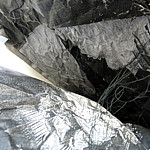
once used for sitting; Moira Williams, Brooklyn,
New York, USA, December 2012 Moira Williams combines the ephemeral presence of time with material tactility to create the event of a chair once used for sitting. The book is an artefact of a performance and made from individuals crumpling, twisting or folding the paper to express loss. It is a single gesture repeated differently by many hands. The crumpled pages are then hinged together with cotton thread to convey both a collective and an individual sense of activity, movement and fragility. Repeated images of a chair with a soft, sprawling object resting in its arms is on one side of the page while an empty chair is on the reverse side. The chair image references the chair's specific architecture as a place to rest, a place for listening to someone speaking with us or to us, to interiorise and to go within. Moreover, the chair reminds us that it can be a place for receptivity, individual encounters and social gatherings all of which have animated the chair's rich social history. The chair is an identifiable human element and acts as a portrait, as do the gestures within the crumpled pages. A portrait that is informed by the chair's varied historical significance and defined through its ongoing metaphorical role in society as academic chair, the cathedra, the judicial bench and the throne. Illustrating how society places an importance on the chair's role. The chair's positioning and style also create a continual dialogue that engages with the social. Placing a chair on a threshold like an entrance into an image or actual steps the artist expresses multiple connections to social space (the chair in the image was placed on the steps of the Kings County, NY Housing Court where Moira sat inviting people to crumple the chair's Xeroxed image). Although the event of a chair that was once used for sitting is now an artefact of a performance, it is an error to witness the previously occupied threshold space as passive; doing so is to deny its spatiality and limit its potential for interrogation. The threshold space becomes transformed by the occupant as well as by the viewer. These two positions construct interpretations of the space. Both the viewer's and the occupant's interpretations have vital significance when the threshold space is considered in the context of an ongoing social commentary. The threshold space is not insignificant, and the perception of this space is not an insignificant act. Moira's work the event of a chair that was once used for sitting enacts the remains of an individual yet collective perception and dialogue of a threshold space between the occupant and the viewer. Each page is meant to remind us of the individual's active relationship to social places, places of exchange and community. And to consider what it means to loose such places and the people who positively activate them like Iraq's al-Mutanabbi Street's bookselling community. Medium: A4 paper, laser jet ink, black cotton thread; Dimensions: Variable; Edition: 3 moira670@gmail.com |